



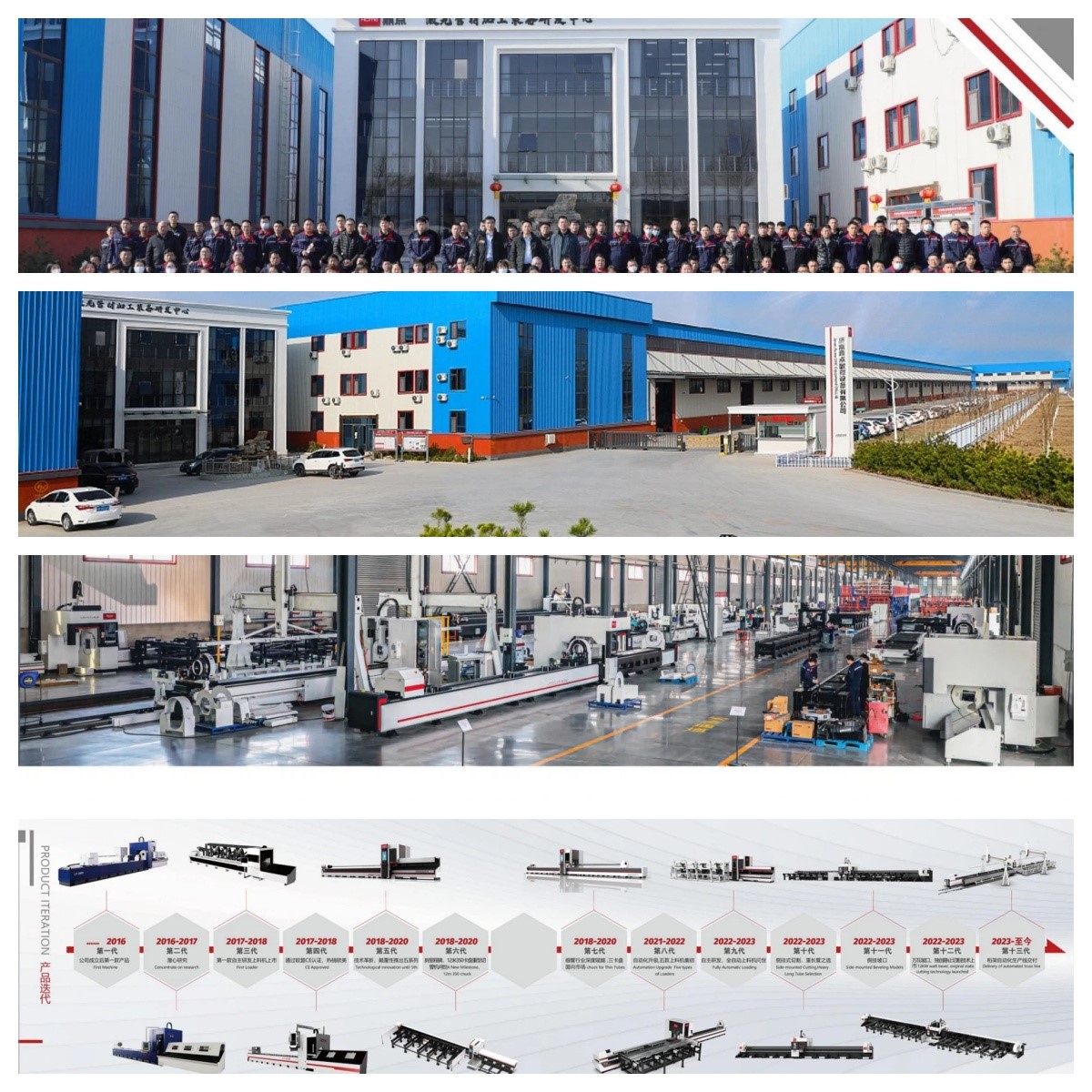
JINAN ACME CNC EQUIPMENT CO., LTD (Acme Laser) was founded in November 2016, located in the Start-Up Area of Jinan City, Shandong Province, China. We are a Chinese high-tech enterprise specializing in R&D, production, and sales of laser equipment.
Focus on Research
Our company has more than 300 employees, including more than 80 R&D technicians, and 100 engineers. We cooperate with universities to carry out research and development and realize the transformation of achievements.
All-Round Services
Acme Laser’s efficient customer service team accounts for 20% of the company’s total employees, offering customers 24-hour considerate pre-sales service, in-sale service, after-sales service, customer training, etc.
Advanced Production Equipment
We have large gantry milling machines, CNC machining centers, machine assembly workshops, and other high-precision production equipment to achieve independent research and design and high-precision manufacturing of core components.
Extensive Market Reach
Tube laser cutting machine is our core product, the cumulative sales of laser tube cutting machine are more than 3,000 units until now, and it is exported to more than 80 countries and regions around the world.


Laser Marking Machine for Sale Display

Fiber Laser Marking Machine
Fiber Laser Marking Machine, widely considered to be the best option in existence, uses fiber pumping technology to “dope” the fibers with a rare-earth element such as Ytterbium. The use of this element increases the ability of the fibers to conduct light-emitting diodes, which are then pumped through the fibers to the optical heads.

CO2 Laser Marking Machine
CO2 Laser Marking Machine uses CO2 gas as the working medium of the laser marking machine with a galvanometer. CO2 laser source takes CO2 gas as the medium and can mark images, text, numbers, and lines according to the user's request.

UV Laser Marking Machine
UV Laser Marking Machines can work at very high speeds and are used to make precise marks on semiconductors and plastics such as PVC, ABS, Polypropylene, etc. Their use can be extended to metals, paper, ceramic chips, etc.

UV Laser Marking System
UV laser with its 355nm wavelength which is versatile in marking a wide range of materials is perfect for "cold marking" applications where heat zones are not allowed. Therefore, our UV Laser Marking System can be utilized in micro marking applications such as electronics and circuit boards.

UV Based Laser Marking System
The UV Based Laser Marking System is Suitable for marking on most materials. Emergency stop, key switch, power switch, shake hand wheel, etc. make it easy to use and safe.

20W Fiber Laser Engraving Machine
The 20W Fiber Laser Engraving Machine is a new-generation laser marking system. It has good beam quality and high-precision marking results. Its life span is up to 100,000 hours, and you can move it to any workplace.
What is a Laser Marking Machine?
Laser marking is a set of non-contact marking techniques used in making permanent marks on the part surface. The marking system of the Laser Marking Machine is non-contact as it uses a laser beam generated by a laser marking machine. Manufacturers can use the marking laser system to create permanent markings in the form of texts, codes, graphics, and numbers on parts and machines without surface damage.

Laser Engraving
This process involves the removal of some materials from components’ surfaces using laser beams. During the process, the material will absorb heat from the laser, melt, and evaporate, creating marks in the form of depressions. The material will also react with air, causing a color change to make the mark more distinctive.
Laser Etching
laser etching process
This highly versatile process creates marks on workpieces by melting their surfaces. The laser beam produces a raised mark by delivering high amounts of energy to a small, localized area. Consequently, the surface will melt and expand, changing the color to black, gray, or white.
Laser Annealing
In laser annealing, the laser beam will heat the material surface locally to create the mark. The beam only penetrates between 20 to 30 µm into the material surface, thereby resulting in a very minimal change on the surface. The localized heating causes color changes in the material. The marking could be black, red, yellow, or green, depending on the temperature of the heated layer.
Laser Marking Machine Types

Fiber Laser Marking
Fiber laser marking machines are compatible with many materials, whether metals, plastics, or composite. They have a 1064nm wavelength and are better suited for metal marking. Furthermore, their high power makes them applicable in laser annealing and engraving. However, they cannot mark transparent objects like glasses because the laser beam will pass through without affecting them.

UV Laser Marking
UV lasers or cold lasers have an absorptive wavelength of 355nm. They are called cold lasers due to the lesser heat dissipation during marking compared to the fiber laser marking systems and CO2 laser marking systems. They are suitable for making delicate parts and pieces of jewelry, and also suitable for glass and plastic.

CO2 Laser Marking
CO2 laser marking machines have high wavelengths (about 10x the wavelength of standard wavelength systems). They are suitable for marking organic substances such as resins, paper, wood, rubber, and plastics. Unlike the fiber lasers, the CO2 laser marking system cannot mark metals due to the non-absorption of the laser light.
Advantages of Laser Marking Machine
Complete Traceability
With laser marking, you get to mark directly and permanently on the part. And unlike other marking methods, the marking process can be performed at the beginning of the production line. Even if the marking is performed before treatments like shot blasting and e-coating, you keep high-quality marks throughout the part’s entire lifetime. You don’t need to worry about preserving the quality of data matrix codes, barcodes, or alphanumeric serial numbers.
No Consumables
Having no consumables simplifies the marking operation, and it contributes to improving health and safety in the workplace by replacing technologies that use chemicals or ink. Getting rid of consumables is also cost-effective since you reduce yearly operation costs.
Bare Maintenance
Laser marking machines and systems have no moving parts, which means that their components are less likely to break. Laser machines thus require less maintenance and are less wasteful than the machines they replace. Their laser source is highly reliable, having a mean time before failure of 100,000 hours, which can represent over 10 years of operation depending on the daily use.
Environmentally Friendly
Laser marking systems do not use consumables such as chemicals compared to inkjet marking. As a result, there is a lesser chance of ejection of harmful materials into the environment. Furthermore, unlike dot peening, laser technology does not produce noise, making them eco-friendly.

Jewelry and Goldsmiths
the laser allows you to obtain precise and accurate engravings in a short time, without damaging the treated object in any way and acting on surfaces that are difficult to reach or on particularly delicate or fragile components. For this reason, the laser can be used successfully in the goldsmith sector or in all other areas of craftsmanship where it is necessary to carry out accurate and precise interventions, paying particular attention to the final aesthetic result.
Micro-Cuts
a correctly calibrated laser marker is able to cut surfaces a few millimeters thick, guaranteeing extremely accurate intervention. The procedure requires a certain amount of time, because the laser cuts by repeatedly passing over the same portion of the object, but the results are particularly satisfactory from the point of view of accuracy.
Photoengraving
The laser also allows for photoengraving on metals, reproducing an image or photograph on the chosen surface. This application exploits the ability of the laser to use heat to engrave the material or to blacken it, and allows to obtain extremely satisfactory results (obviously influenced by the resolution of the starting image).
Components of Laser Marking Machines
Laser Source
This component is the heart of the laser printing machine. It generates a high-intensity laser beam. It is the foundation for the marking process. In this case, the laser source determines the type and power of the laser used. Different materials require different laser wavelengths and strengths for optimal marking quality. The laser source is critical in achieving precision and accuracy in markings.
Control System
This component manages and coordinates the entire laser marking process. It includes hardware and software components that regulate the laser’s parameters. Some parameters include laser intensity, speed, and scanning patterns. This device interprets instructions from the operator and translates them into laser movements. It ensures that the laser marking machine operates consistently and accurately.
Computer CPU
We can call it the brain of the laser marking machine’s control system. It runs the necessary software for designing, configuring, and executing laser marking tasks. It processes complex algorithms and coordinates data flow. It communicates with the various components of the machine and ensures seamless operation. The user interface displayed on the computer monitor allows operators to interact with the device. It also allows you to make real-time adjustments.
Other Accessories
Other accessories are connected to the control system except for the above parts. These additional components include safety interlocks, exhaust systems, cooling systems, and rotary attachments.
The laser marking technology creates lasting marks on component surfaces by generating focused beams of light containing high energy levels. The built-up energy is released in the coherent light beam directed at the material surface using mirrors.
As a result of the light beam interacting with the component’s surface, there is a transfer of heat energy from the beam to the surface. Therefore, the appearance and properties of the material will change. Depending on the energy level, the laser can engrave, etch, anneal, or discolor surfaces with great precision.
The concentrated beam targets only specific areas on the material, ensuring precise, high-contrast, and high-quality marks. These marks are permanent, and you can easily read or scan them on any surface. As a result, this marking process is ideal for operations where permanency and accuracy are critical.

Create a Routine
The best way to maintain any sort of heavy equipment is by creating an inspection routine. Ensuring you regularly inspect your laser marking machine can help prevent damages and other operational issues. Using the included resources, such as manuals, give your device a thorough check-up before and after use. Look for anything out of the ordinary, like broken and/or misaligned parts or components. If you’re unsure of anything concerning this routine inspection, it’s best to contact the distributor for more information.
Use Proper Techniques
Industrial laser marking machines are complex and require proper operating procedures to ensure success and reduce the likelihood of functional problems. Even though these devices are very hands-off regarding human labor, you still must always operate the machines correctly. Training is obviously important as it can help you identify issues before they get out of hand, helping extend the lifespan of your device. We recommend reviewing workplace and operation standards every few months to keep them fresh and at the top of your mind. By committing to perfection and thoughtfulness while working, your laser marking equipment will remain functional for years to come.
Clean Often
When we say “clean often,” we mean often. You should conduct a quick cleaning before and after each and every use of your device. The most important thing to do each time is clean the lens as it is an essential component that gets dirty quickly. Turn off your equipment before cleaning the lens to avoid accidental injuries. Be thorough but not too aggressive as these objects are fragile and can be damaged with improper techniques. You may need to remove a lens during this process, so ensure you handle the part with care. Aside from lens maintenance, wipe off any debris on your laser marking machine when possible. By cleaning every day, you can increase the functionality and lifespan of your equipment significantly.
Our Factory
Our factory covers an area of over 50,000 square meters, with a variety of professional production equipment.
Patent Certificate & Technical Resources
Our company has obtained certificates such as Europe CE, America FDA, ISO 9001, Canada CAS, and many kinds of national patent awards.

Ultimate FAQ Guide to Laser Marking Machine
Q: What are the applications of laser marking?
Q: What materials can be marked with a laser marking machine?
Q: What is the difference between laser ablation and laser marking?
Q: Does laser marking disappear?
Q: I should not look directly at laser light, right?
Q: What does “marking space” mean?
Q: What is the maximum marking speed of a laser marking machine?
Q: What is laser marking for parts?
Q: How deep is laser part marking?
Q: Is it possible to mark barcodes and QR codes with a laser marking machine?
Q: Can laser marking be used for medical devices?
Q: What is the resolution of a laser marking machine?
Q: Can a laser marking machine mark round or curved surfaces?
Q: How do I maintain the lens of my laser marking machine?
Q: Can I laser mark on the glass?
Q: How to choose line thickness for laser marking?
Hot Tags: uv laser marking machine, China uv laser marking machine suppliers, manufacturers, factory


